A Summary of Results from the Australian-based, Global Internet Paruresis (Shy Bladder) Survey, conducted in 2004.
Reviewed by the researcher, Russell Gibbs
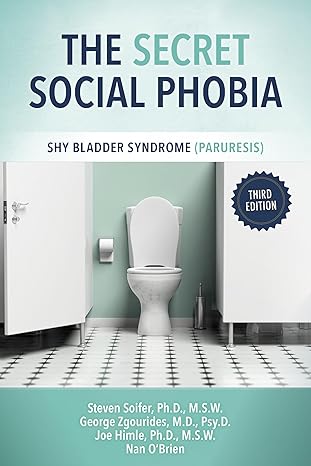
Paruresis (Shy Bladder Syndrome) is the inability to urinate with others present, a relatively common, but poorly researched and little understood, specific social phobia. In the largest paruresis study performed to date, 264 adult paruretic males aged 18 –80 completed a global, anonymous Internet survey over a 4 month period in 2004.
The sample was well distributed demographically, representing diverse social strata and geographical location. Seventy percent were university educated, comprising 44% undergraduate and 26% post-graduate, the remaining 30% having trade qualifications and a variety of educational and training backgrounds. Approximately half the sample was either married or de-facto (44%), divorced or separated (6%), or widowed, and the remainder (49%) were single. Fifty-one percent were employed full time, 5% part-time, 13% self-employed, 7% unemployed, and 17% were students. Country of residence representations comprised 50 from Australia and New Zealand, 120 from North America, 8 from Europe, 55 from United Kingdom, 12 from Canada, and 19 from other nations. The diverse population from over 20 countries also included Finland, Switzerland, China, Malaysia, India, British Columbia, Brazil, and Iceland.
Scale to Measure Paruresis
As no established scale to measure paruresis was available, I constructed the Paruresis Severity Scale (PSQ) specifically for this research. The PSQ Scale contained 11 items and proved to be a statistically reliable measure suitable for use in future research. The PSQ Individual Items comprised additional questions about paruresis history, personal experience, and related issues. The highest scores on the PSQ scale (answering mostly or always) related to anxiety when using restrooms (94%), urination failure causing stress (88%), and feeling judged when voiding (75%), with searching for vacant restrooms (86%) also scoring highly. Only 2.7% never used stalls and 74% mostly or always did. The highest scores in lifestyle areas indicating paruresis was not an issue related to job opportunities (41.7%), urinating at home (19.3%), and restricting liquid intake (14.0%), with the remaining scores much lower, meaning that most men had problems relating to all 11 questions.
Over half those surveyed were unable to urinate successfully at public urinals, avoided public toilets, and believed paruresis affected the personal, social, or employment aspects of their lives.
PSQ History
PSQ History revealed that the age paruresis was first experienced was 12 and below for 45% of respondents, 13 – 18 for 44%, 19+ for 11%, with 43% reported having the problem for over 30 years. Only 25% reported any improvement with age, of whom 51% attributed the reason to increased coping skills and relaxation. Interestingly, 14% reported familial history of paruresis; however, a large percentage (61%) of the participants were unsure of any family history. This suggests there is an hereditary factor.
Although 44% sought treatment the majority of those waited 20 – 30 years before seeking help. The most common treatment methods were psychotherapy (47%), graduated exposure therapy (36%), self help group (32%), medication (28%), and cognitive behaviour therapy (24%). Success rates for these treatments were reported as low: no improvement 44%, some improvement 38%, great improvement 15%, and problem overcome only 2%.
PSQ Related Issues
PSQ Related Issues revealed that the most commonly reported situation of first experiencing paruresis was at school (58%). Perceived causes of developing pauresis placed anxiety, shyness, and embarrassment as prominent. A Related Issue gaining publicity, particularly due to its growing incidence in North America, is compulsory urine sampling under observation, such as in employment related drug screening. Results revealed that 13% of participants had given a sample, while 93% indicated they would, “…feel stress/anxiety if having to do so”. The last question of the PSQ, participants’ comments, attracted substantial interest from 181 men who provided personal experiential information about paruresis amounting to over 15,000 words. This valuable information will be the subject of another paper.
The psychological questionnaires revealed that the men surveyed scored significantly higher than the general population on private self-consciousness (meaning they dwell on negative aspects of the self as well as having an interest in self-awareness), neuroticism (tending to be anxious and worry a lot), and conscientiousness (reliable and complete tasks to a high standard). Another important result, which contributed to the development of a personality profile of men with paruresis, was that the sample tended to be introverted (shy, withdrawn) and aligns with them also being highly self-consciousness.
Summary
In summary, these results combined with other findings from the survey not discussed here, suggest that paruresis was the main social problem experienced by most of the sample, and that self-conscious attention to urination performance (more so than physiological anxiety symptoms) may be the main factor in urination breakdown. The study presented a self-consciousness model of urination ‘freezing’ as an alternative to the existing ‘fight or flight’ model based solely on high levels of anxiety, and results provided initial support for this model.
Future treatment programs could therefore benefit from exploring the cognitive (thoughts and self-talk) aspects involved in the anticipatory fear and consequential failure to successfully urinate when in the presence of others. Cognitive Behaviour Therapy (CBT), when combined with graduated exposure therapy (systematic desensitisation) currently promoted by Professor Steven Soifer and the International Paruresis Association (IPA), paruresis organisations in Australia (PAA), Britain (UKPA), and Europe (EPA), may result in greater success in treatment sessions and relapse prevention (misfires). Established CBT methods used in psychology to change irrational beliefs can be applied to paruresis (e.g., I’m abnormal because I cannot pee in public facilities), negative self-talk (e.g., I’m hopeless and will always have trouble urinating), and unfounded beliefs (e.g., no one would understand – I’ll have to suffer alone), are strongly suggested based on the results of this comprehensive study on paruresis.
Australian people experiencing paruresis (Shy Bladder Syndrome) are welcome to contact me for professional advice and treatment therapy. Paruresis need not be a lifetime burden, as has been demonstrated in testimonies from those who have learnt to manage or overcome it (see Paruresis Association of Australia website: https://www.paruresis.org.au/).
For Appointments Contact
For appointments contact:
Russell E Gibbs
B.Psyc (Honours)
Intern Psychologist
(Reg. No PS0093701: NSW)
Associate Member of the Australian Psychological Society
Email: gibbs.psychology@bigpond.com
Phone: 02 65856311
Mobile: 0427 240 576
Postal address:
Russell E Gibbs
Gary S Grant & Associates
Consultant Psychologists
Suite 2/5 High Street
Wauchope NSW 2446. Australia